Showing posts with label Green. Show all posts

Sunday, March 17, 2013

Revolutionary War Patriots

I have always been aware that there were a few ancestors down the line who fought in the Revolutionary War. But imagine my surprise when I began a quick search using the Daughters of the American Revolution (DAR) Genealogical Research System and found a whopping ten patriots! And that is just in my maternal lineage - there are even more on my father's side of the family. It was a challenge to wrap my head around all the relationships, so I created the following chart with patriots marked in red (click the graphic to view it in a larger size):

Revolutionary War Ancestors of Margaret (Green) Livingstone


Of particular note to me were some of the relationships I found. For instance, the three pairs of men whose children eventually married each other: Jotham Bigelow's son Josiah wed David Culver's daughter Sarah; David Redman's son Michael wed Moses Carpenter's daughter Susannah; Simeon Ballou's son Abraham (also a veteran) married Gideon Mowry's daughter Diana. Here are the names that correspond to the chart:
  1. Jotham Bigelow (1717-1876)
  2. David Culver (1736-1801)
  3. David Redman (1758-1838)
  4. Moses Carpenter (1751-1829)
  5. Adonijah Taylor (1730-1802)
  6. Simeon Ballou (1740-1786)
  7. Abraham Ballou (1764-1843)
  8. Gideon Mowry (1736-1795)
  9. Edmund Ranger Bird (1759-1835)
  10. Moody Howes (1725-1806)
The veterans listed here are, of course, only from my maternal grandmother's lineage. My grandfather's family, the Livingstones and Smiths, came to America from Scotland and England much more recently... so it's entirely possible that someone down the line was standing on the opposite side of the battlefield, facing their future in-laws!


Monday, February 25, 2013

Mothers and Daughters

I was going to save this one for mother's day, but I didn't want to wait! I love multi-generational photos, especially candid ones. They really help to put the people of the past in perspective - facts and dates are great, but they fall flat on personality. Even better are photos of mothers and daughters, where you can see who takes after who (or doesn't).

The first picture below, taken about 1924, features my grandmother as a baby, her mother, her grandmother, and her great-grandmother. From left to right, they are: Florence (Brown) Green, Edna (Redmond) Brown, Margaret Green, Harriet (Shuler) Redmond. Three of these lovely ladies return in the second picture, taken about 1947. Standing are Florence (Brown) Green and Margaret (Green) Livingstone; seated are Edna (Redmond) Brown and my aunt.


Grama passed away when I was still in high school, so hopes of another four-generation "mothers and daughters" photo like these will have to wait until I myself am a grandmother! Or will it...


Left to right are: mom, my sister, me, my grandmother, my great-great-grandmother, and my great-grandmother. Taking center stage is my great-great-great-grandmother. Six generations in one photo! ...and yes, I know there are a hundred or so glaring conflicts as a result of my hasty Photoshopping. Sizing, texture, value... not to mention the shadows on everyone's faces going in different directions. Maybe one day when I have a better selection of hi-res photos I will update this with a more cohesive version! ;)

Thursday, February 21, 2013

Cats!

It's not a huge surprise to find pictures of Grama, her mother, and her grandmother with cats in their arms... they lived on farms, after all! Clearly this affinity for felines has been passed down through the generations!

  
Edna (Redmond) Brown, c. 1920? Florence (Brown) Green, c. 1921

  
Margaret (Green) Livingstone, c.1936Bibs and me, 2012

Thursday, February 7, 2013

Ralph Orville Green

Ralph and Florence Green, 1943
My great-grandfather has always been a bit of a mystery to me. I never heard Grama volunteer information on the subject, and I never thought to ask until it was far too late. I knew he was from the Flint area. I also knew his parents died when he was young; someone mentioned they may have been doctors, and that one or both were killed in a car accident. I also knew he was wounded in France during World War I, an injury that left him with chronic pain for the rest of his life. Everything else has come together in bits and pieces.

Ralph Orville Green was born in Flushing, MI, in 1892, the youngest child of Charles Herbert Green and Mary Effie Taylor. His maternal grandfather was Lewis Taylor, a medical doctor in Flushing, which clarifies that tidbit of history. In 1899 Ralph's father died of typhoid fever, leaving seven-year-old Ralph and his two siblings (Everett and Edna) to be raised by their mother - the 1900 census lists her as the head of household. All of their grandparents were deceased by that time, so he did not have much family around.
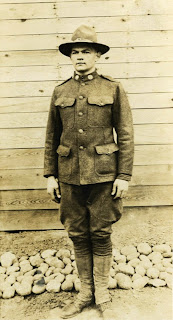
Ralph Green, 1917-18
Just a few years later, in 1906, Ralph's mother died at the age of 42; by then, his brother Everett was living in Ohio with his wife, Nellie, and young daughter Elloise. When the 1910 census came around, Everett was back in the Flint area with his family, and his sister, Edna (age 22), was living with them. Ralph, however, was living with Jules and Hattie Houle in 1910 (and 1920). The Houles are referred to several times in later letters from Florence to her mother, and they considered him family.

On June 5, 1917, when he was 25 years old, Ralph registered for the draft, claiming exemption due to his occupation as a farmer. Whether he volunteered soon afterward or was called up for service, I don't know, but either way, he soon found himself an enlisted man of the 115th Infantry Regiment, Company G, training at Camp McClellan and bound for France.

One resource I came across, entitled The 115th Infantry, USA, in the World War, is available online and contains details and photos of the regiment during the war (Ralph is listed on page 229). Recorded by the chaplain, it covers everything from training to crossing the Atlantic and, finally, travelling via train, truck, and foot across France. There they wound up on the front lines, in the trenches near Verdun. The regiment played a major role in the Meuse-Argonne Offensive, a six-week-long battle that led up to the end of the war. There were estimated 117,000 US casualties during the campaign (over 26,000 killed), and right in the midst of it was Ralph vs. a machine gun.

Ralph was shot in the leg around October 10, about a month before the armistice on November 11. The bullet came from "a Fritz machine gun," meaning a German weapon, but I'll let him tell the story, from a letter he wrote to the Houles.

Friday Oct. 18, 1918
Somewhere in France
My Dear ones at home,

I will write you a few lines to let you know I am still alive and doing fine but gee it is hard work to lay so still in bed so long and this is only eight days and to think it might be nearly that many weeks before I can get up and walk much, but thank God it is no worse than it is there are many much worse off than me and many that are past there [sic] suffering that will never return, for this is an awful war, but thank God we all think it is near over. Hope and pray so anyway.


From The 115th Infantry, U.S.A., in the World War  by F.C. Reynolds.

Well I suppose you are anxious to here [sic] how and where I am wounded. I got hit in the left leg with a shot from a fritz machine gun. It hit the bone and shattered it so that there were several pieces to be removed and it will take some time for it to lengthen out and grow together again you see.


From The 115th Infantry, U.S.A., in the World War  by F.C. Reynolds.

Sunday afternoon will try and finish this letter. Don't know of much I can write, I am feeling pretty fair and getting along very good. The weather is very cold and cloudy and the days seem long and dreary and that's the way it goes here in France.

I don't know when I will here [sic] from you again as it will take some time to get my mail forwarded as it will go to the Co. and they don't know where to send it so it will go to the main headquarters and might fin'ly get to me but it will be good when it does come. I see by the papers that the huns are still on the run.

Hope this will find you all well. Will close for this time hoping to here [sic] from you soon. Good bye with love and best wishes.
From your boy,
Ralph O. Green
Co.G 115th US Inf.

After the war Ralph met my great-grandmother, Florence Brown, and they were married in 1922. They lived in Flint for a few years, where my grandmother was born. During their time there, Mrs. Houle was hit by a car and died shortly thereafter, an event described in detail by one of Florence's letters home. More about that in another post... but it seems I found the source of the rumor of his parent(s) being killed in a car accident.

Florence, Margaret, Harold, Ralph Green, 1928-29
Soon their son Harold came along, and it wasn't too long before the Greens moved to Byron, settling on a farm close to Florence's parents' home. The next years must have been difficult as the Great Depression descended on the country, but life moved onward and the kids grew up, married, and added their own children to the family. That pretty much brings this to a close! I never had the opportunity to meet my great-grandparents, as Florence died rather unexpectedly in 1954, and Ralph in 1966, but I imagine they were honest, hard-working, and more than a little tough from the challenges they faced.

Thursday, January 31, 2013

Grama's School Years

Peggy and her school books.
Over the years I've come across a lot of photos of my grandmother, but most are either from her early childhood or after she was married to my grandfather. Lately I've been putting together a collection of anything in-between.

Margaret Louise Green (a.k.a. Peggy) graduated with 25 other students from Byron Agricultural School, the same school her mother and grandmother attended, in 1941. From there she was off to Michigan State College of Agriculture and Applied Science, better known today as Michigan State University.

Peggy did not finish her degree at MSC - she married my grandfather in 1943 and was off to live in California while he served on the U.S.S Barnes in World War II. She did not abandon school completely, of course, and finished her bachelor's degree at Eastern Michigan University in 1961, followed by a master's degree soon after.

Margaret in her high school band uniform (and clarinet).

Byron Agricultural School bus.

Byron Agricultural High School, 1941

Margaret in her high school graduation attire.

Byron Agricultural High School Class of 1941.


Margaret's MSC ID card.

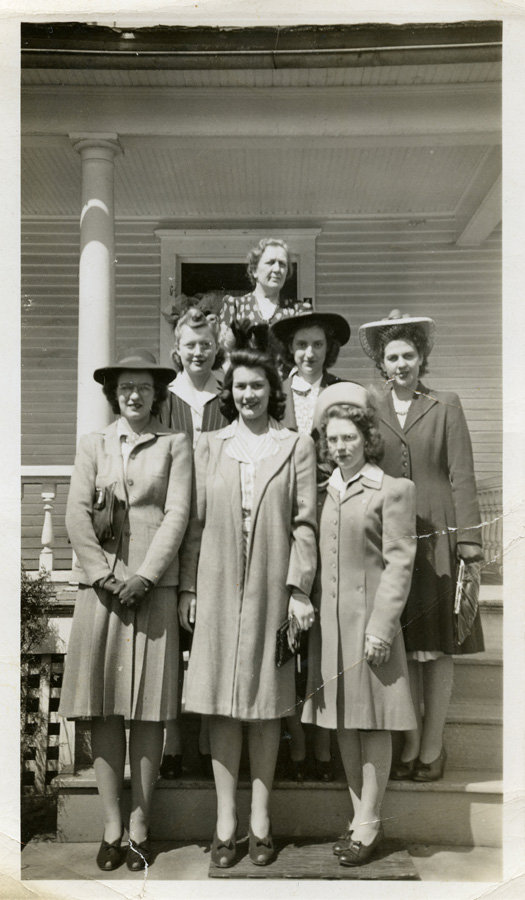
Margaret (front, center) with her housemates at MSC.

Wednesday, October 31, 2012

Ties to Sleepy Hollow

The Old Dutch Church of Sleepy Hollow
Remember reading the story The Legend of Sleepy Hollow, by Washington Irving? It tells the tale of the schoolteacher Ichabod Crane, who came to Sleepy Hollow and disappeared after encountering the headless horseman, a ghost known to ride each night in search of his missing head. Maybe you saw the Disney version, or the more liberally adapted Tim Burton version. Either way, the original is free online at Bartleby.com if you want to revisit the tale!

The location and characters in Irving's story are based in reality - Sleepy Hollow is a village located near the larger community of Tarrytown, New York. The Old Dutch Church of Sleepy Hollow figured prominently in the story, as did the adjacent churchyard, where the horseman was said to tether his horse each night after his ride.

I bring up the topic of the Old Dutch Church because, as it turns out, not only are a few of my ancestors from the Tarrytown area, but records show that they were members of that very church around the same time as the other townspeople who inspired Irving's story.

The Old Dutch Church, now the Reformed Church of the Tarrytowns, is the oldest standing church in New York, and it's very fortunate that its early records were preserved and digitized (check it out for yourself here at Google books). It can be tricky to find information, though, since the original records were written in Dutch, and there was considerable inconsistency in the spelling of names.

Matthys and Maritje Brouwer, my ninth great-grandparents, are listed among the earliest members of the church, along with their son, Samuel, and his wife Grietje. Their grandchildren are all listed in the register of baptisms, among them Johannes, who we also find in the register of marriages, wed to Eliezabeth Canckely (a.k.a. Elizabeth Concklin) on September 2, 1733. Their son, Deliverance (or Leverens), was baptized elsewhere, but reappears in the Old Dutch Church records with the baptism of his daughter, Eva, on April 27, 1762.

There are a few things about Eva, my fifth great-grandmother, that have piqued my interest. It is widely believed that the inspiration for Katrina Van Tassel, Ichabod Crane's love interest in Irving's story, was a woman by the name of Eleanor Van Tassel. Born in 1763, Eleanor was the same age as Eva, so it seems likely they knew each other. In any case, Eva married Edmund Bird, a soldier in the Revolutionary War; their son, Edmund Ranger Bird, is listed as being baptized August 28, 1785 in the Old Dutch Church. Eva was also known as Effie, a name which shows up a few times as my maternal line progresses: her granddaughter, Effie Linda (Bird) Taylor, bore the name, as did her daughter, Mary Effie (Taylor) Green, who is my great-great-grandmother.

The last tie to Sleepy Hollow that I can't resist speculating about is the character of Old Brouwer, who is described as "a most heretical disbeliever in ghosts" who does an about-face when he encounters the headless horseman one night. I can't help but wonder if he's inspired by one of our own ancestors!

Happy Halloween, everyone!

Saturday, October 6, 2012

Scanning Update

After last night's batch of scanning photos I thought I'd post a tally of my progress so far... 377 scans! Some of these are scans of documents, or the back of a photo that has a lot of writing on it, but that is still well over 300 photos. And that barely makes a dent in the pile.

I've been sorting the photos I scan as I go, using archival (acid-free and lignin-free) file folders, with acid-free paper separating each photo so they do not fade. These are then labelled and filed in small, easy to manage paper storage boxes which are about half the size of standard banker boxes.

Here are a few of the results! In the upper left is my grandmother Margaret (Green) Livingstone, her younger brother Harold and her father Ralph. In the upper right is my great-great-great-grandmother Harriet (Shuler) Redmond. Below is my great-grandmother, Laura (Smith) Livingstone, with three of her children: Mae, Laura, and Jack, my grandfather.